
The Liquidity Paradox: Why Capital Flowed into Algorithms, Not Altcoins
The Liquidity Paradox: Why Capital Flowed into Algorithms, Not Altcoins
Published on: 12/8/2025
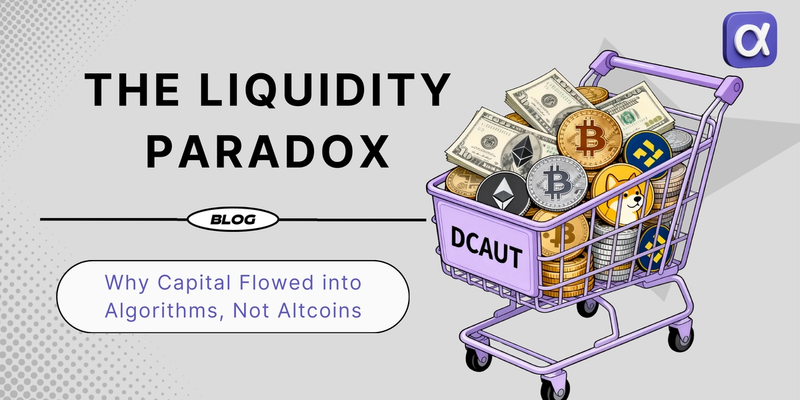
I. Market Observation: The Failure of "Waterfall Theory" and Real Capital Flows
In the traditional cycle model of the crypto market, investors adhere to the classic "Waterfall Theory": capital first flows into Bitcoin (BTC) to drive up market cap, then overflows into Ethereum (ETH), and finally floods into small-cap assets (Altcoins), triggering a so-called "Altseason."
However, market data from 2024-2025 is falsifying this empirical path.
Although BTC has repeatedly touched or broken historical highs, liquidity for small-cap assets has not recovered as expected; many assets have even hit multi-year lows relative to BTC. Data from Bloomberg Terminal and Associated Press indicate that the incremental capital in this cycle primarily originates from passive Index Funds (ETFs) and Macro Hedge Funds. This capital is characterized by extreme "Risk Aversion" and "Compliance Rigidity."

The core pain point is this: Capital has overflowed, but it has not flowed into the "risk asset depression." Instead, it has moved toward "risk-free arbitrage" and "defensive hedging."
For the average investor, this creates a deeply fragmented experience: index prosperity versus account losses. The market no longer rewards blind Beta chasers. Simple "Buy and Hold" strategies are failing in this environment of liquidity stratification. If capital no longer floods the entire market, how do investors generate Alpha?
The answer lies deep within the market's microstructure: Capital is overflowing from "Directional Betting" to "Volatility Trading."
II. Deep Analysis: When "Volatility" Becomes the Only Certain Asset
From the institutional perspective of Goldman Sachs or Morgan Stanley, when an asset class becomes massive and cumbersome due to institutional intervention, its volatility naturally decreases, and the slope of unilateral gains flattens. At this stage, Alpha no longer comes from "picking the right asset," but from "deploying the right strategy."

This is the market entry point for DCAUT (Dollar Cost Averaging Ultra-Trading), a compliant quantitative platform.
The market is undergoing an "Industrial Revolution." In the past, trading was an artisanal workshop model reliant on intuition and emotion. Now, due to ETF capital control, price action exhibits highly algorithmic characteristics—frequent false breakouts, liquidity hunting, and narrowing oscillation ranges.
Addressing this structural change, DCAUT’s solution is not a simple stack of tools, but a dimensional upgrade in trading logic:
- Entropy-Resistant Enhanced DCA: Traditional DCA is linear and blind. DCAUT’s Enhanced DCA strategy is effectively "Non-Linear Cost Management." Through intelligent algorithms, it calculates support density in real-time. In a downtrend, it does not buy mechanically; instead, it adjusts position weighting based on volatility. This lowers the cost basis significantly faster than the market decline, allowing for a breakeven point at the very onset of a rebound.
- Noise-Capturing Dynamic Tracking: In institution-dominated trends, movements are often accompanied by violent washouts. Retail traders easily lose their positions during these oscillations. DCAUT’s Dynamic Tracking strategy addresses the psychological weaknesses of "taking profit too early" and "cutting losses too late." It utilizes a trailing stop-profit algorithm that remains silent while the trend continues and executes only when a statistically significant reversal occurs. Mathematically, this maximizes the Profit/Loss ratio.
Capital has not vanished; it simply no longer rewards simple holders. It now rewards participants who extract volatility value via algorithms. The core value of DCAUT lies in democratizing institutional-grade strategies—allowing ordinary capital to extract "profit signals" from "price noise" through a combination of Grid and Martingale strategies.
III. Macro Speculation: The Paradigm Shift from "Gambling" to "Farming"
If we reference the cycle definitions from Sequoia Capital or Grayscale, a clear trend emerges: the maturity of any financial market is marked by the democratization of arbitrage opportunities.
In the early crypto market, wealth was derived from "information asymmetry" and "early adopter dividends." It was a gold rush fueled by chance. In the post-ETF era, the market has entered a "Cultivation Period." Investors can no longer be speculators looking for a gold mine; they must become farmers practicing precision management.

This concerns a higher-dimensional view of wealth: Do you seek an uncertain 100x return in a single gamble, or do you wish to build an Antifragile System that generates certain cash flow amidst market uncertainty?
DCAUT attempts to construct this exact Antifragile System. By combining cross-exchange unified risk control with intelligent signal sources, it transforms trading from the metaphysics of "predicting the future" to the mathematics of "responding to the present." Whether the market surges, crashes, or consolidates, the strategy engine finds the corresponding survival and profit mechanism. This is not just an evolution of tools, but a reconstruction of the relationship between investors and the market—shifting from a "victim" who passively endures volatility to a "beneficiary" who utilizes it.
IV. Conclusion: Locating Humanity in the Algorithmic Jungle
Research from Harvard Business School on behavioral finance points out: The mechanism of the human amygdala makes us biologically unsuited for trading. We rush to exit in fear and add positions blindly in greed; in a high-frequency market dominated by algorithms, this is akin to fighting machine guns with bare hands.
This provides the ultimate answer to "Where is the funds' next stop?"
The next stop for overflowing capital is not a specific Token, nor a vague new concept, but "Machine Agency."
The future market will be a game of Algorithm vs. Algorithm. DCAUT exists to provide professional armament for non-institutional investors. It allows us to retain a sense of calm control over our assets within the cold flood of digital numbers.